
Advanced measuring and control software solutions with intelligent display and monitoring systems. From single-channel readouts to multi-channel SPC workstations, the digital brain behind every PFL measurement system.
Every PFL measurement solution, whether a simple air plug on a shop floor or a multi-station automated inspection cell, requires electronics to convert, display, process, and communicate measurement data. Our Displays & Software product line is the intelligence layer that transforms raw sensor signals into actionable quality information.
PFL provides a complete signal chain: air converters that transform pneumatic back-pressure into proportional analog signals, air-to-electronic converters that bridge pneumatic and digital worlds, display units with touch screen HMI for real-time visualization, and SPC software that turns measurement data into statistical process control, Cp/Cpk calculations, control charts, histograms, and production reports.
For automated systems, our PLC-based control software manages entire measurement cycles: part detection, probe actuation sequencing, multi-channel data acquisition, OK/NOK sorting decisions, and closed-loop feedback to upstream CNC machines via Profinet, EtherNet/IP, or Modbus protocols.
PFL's software and display systems are not off-the-shelf generic tools, they are purpose-built for dimensional metrology, designed by engineers who understand that a bore diameter displayed in microns demands different visualization and analysis than a temperature reading or a weight measurement.
Simultaneous data collection from multiple air gauging channels and electronic probes in a single measurement cycle. Each channel independently configured for range, resolution, and tolerance limits.
Cp, Cpk, Pp, Ppk calculated in real time. X-bar/R charts, histograms, trend analysis, and control limit monitoring. Automatic alerts when process capability falls below threshold.
Bargraph column displays with color-coded tolerance zones: green (in-tolerance), yellow (approaching limit), red (out-of-tolerance). Instant operator feedback, no interpretation needed.
Measurement data exported to plant-wide quality systems: Q-DAS compatible format, CSV, database connectivity. Every measurement timestamped with part ID for full traceability.
Intuitive HMI panels designed for shop floor operators wearing gloves. Large buttons, clear graphics, guided measurement sequences that eliminate operator errors.
Industrial communication via Profinet, EtherNet/IP, Modbus TCP/RTU, RS-232, USB. Seamless integration with Siemens, Allen-Bradley, Mitsubishi, and other PLC platforms.
Six product categories covering the complete measurement signal chain, from sensor output to management report.
Pneumatic-to-analog converters that transform air back-pressure from air plugs and rings into proportional electrical signals (typically 0–10V or 4–20mA). The foundational interface between your air gauging tooling and any electronic display or control system. Available in single and multi-channel configurations.
Bridge modules that convert pneumatic measurement signals directly into digital data streams compatible with PLC inputs, industrial PCs, or PFL display units. Eliminate the analog intermediate step for cleaner signal chains in automated systems. Support multiple air channels with independent linearization and calibration.
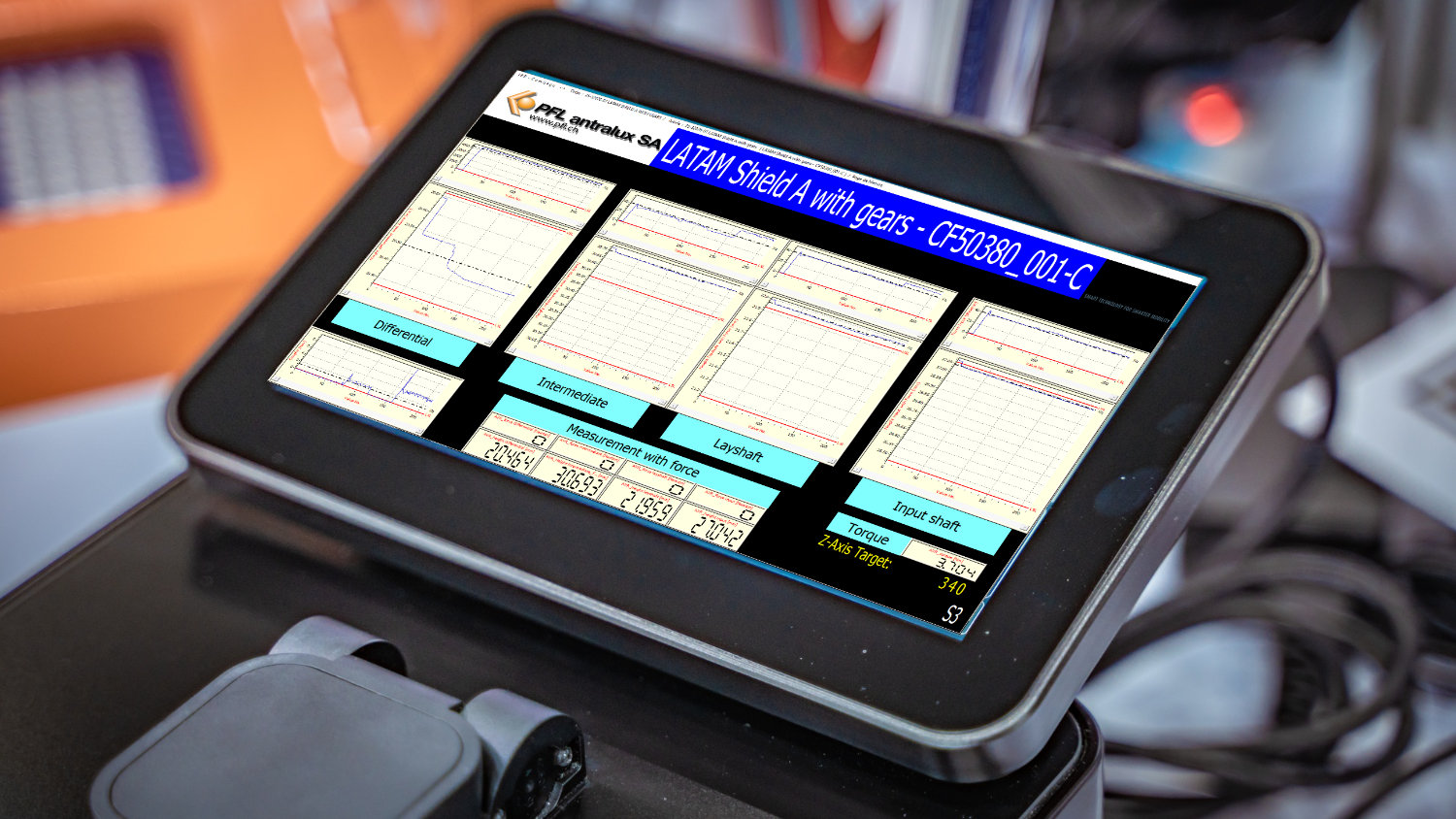
Touch screen display units ranging from compact single-channel readouts to multi-channel industrial panels. Bargraph visualization with color-coded tolerance zones, numerical readout with configurable resolution, and graphical trend display. Machined aluminum housings for IP-rated protection in harsh shop floor environments with cutting oil and metal chips.
Statistical process control software that runs on PFL display units or customer PCs. Real-time Cp/Cpk/Pp/Ppk, X-bar/R control charts, histograms, run charts, and scatter diagrams. Configurable alarm limits, automatic batch management, and data export in Q-DAS, CSV, and database formats. Supports up to 32 measurement characteristics per part program.
Custom PLC programs (Siemens S7, Allen-Bradley, Beckhoff) that manage automated measurement cycles: part presence detection, probe sequencing, multi-channel data acquisition, OK/NOK classification, sorting actuator control, and closed-loop CNC tool offset correction. Includes touch screen HMI for operator monitoring and parameter adjustment.
Hardware and software modules for industrial network integration: Profinet I/O device modules, EtherNet/IP adapters, Modbus TCP/RTU gateways, OPC-UA servers, and discrete I/O interface cards. Enable measurement data to flow from the gauging station to plant-level MES, ERP, and quality management systems.
PFL measurement software is not a generic SPC package, it is purpose-built for dimensional metrology. Every screen, every calculation, every data flow is designed around the specific requirements of measuring bore diameters, shaft dimensions, depths, heights, angles, form, and position.
The software manages the complete measurement workflow: part program selection (manual or automatic via barcode/RFID), calibration verification against masters, measurement cycle execution, real-time display with tolerance evaluation, statistical analysis, data archiving, and report generation.
Store up to 128 part programs with individual tolerance settings, measurement sequences, calibration references, and display configurations. Switch programs via touch screen selection, barcode scan, or PLC command.
Static and dynamic measurement: single-point capture, min/max tracking, average over N readings, peak detection, runout (TIR). Configurable sampling rate for dynamic applications like in-process grinding.
Built-in mathematical engine for derived calculations: average diameter from multiple jets, ovality (Dmax - Dmin), taper, concentricity, true position, 3-point bore diameter. Trigonometric functions for angular measurements.
Store up to 30,000 measurements per part reference with timestamp, operator ID, and batch number. Generate production reports with measurement summaries, statistical analysis, and trend visualization. Export to USB, network share, or directly to Q-DAS.
From the air jet at the workpiece surface to the SPC report on the quality manager's desk, here is how PFL's display and software systems transform physical measurement into digital intelligence.
Air plug, air ring, or electronic probe contacts the workpiece and generates a physical measurement signal
Air converter or air-to-electronic converter transforms pneumatic back-pressure into digital data
Display unit or PLC applies calibration, linearization, formula calculations, and tolerance evaluation
Touch screen shows bargraph, numerical value, OK/NOK status. Operator sees result instantly
SPC analysis, data archiving, report generation, CNC feedback, and plant system integration